Ensuring Compliance with AI Governance Solutions
Artificial intelligence (AI) is transforming enterprise operations across industries, driving innovation and efficiency. However, as AI adoption accelerates, so do the risks associated with governance, compliance, and security. For CIOs, CISOs, CTOs, and IT infrastructure leaders in regions such as Dubai, Germany, Switzerland, the Netherlands, and India, ensuring AI governance compliance is no longer optional. It is a critical component of maintaining operational integrity, managing risk, and enabling business agility.
This article explores how AI governance solutions can be engineered to meet stringent compliance requirements while supporting scalable, secure, and measurable outcomes. It offers practical insights into integrating AI governance within existing cloud and security architectures, with a focus on zero-trust principles and operational transparency.
The Imperative for AI Governance Solutions in Enterprise Environments
AI governance solutions are designed to provide a structured framework for managing AI systems throughout their lifecycle. This includes data management, model development, deployment, monitoring, and auditing. Enterprises face unique challenges in this space:
Regulatory Compliance: Adhering to data privacy laws such as GDPR, and emerging AI-specific regulations in EMEA and APAC.
Risk Mitigation: Preventing bias, ensuring explainability, and avoiding unintended consequences in AI decision-making.
Security: Protecting AI models and data from adversarial attacks and insider threats.
Operational Control: Maintaining visibility and control over AI workflows to ensure accountability.
For technology leaders, the goal is to embed governance controls without compromising innovation velocity or cloud transformation initiatives. This requires AI governance solutions that integrate seamlessly with existing infrastructure and security frameworks.
Key Components of Effective AI Governance Solutions
Policy Definition and Enforcement
Establish clear policies for AI usage, data handling, and ethical considerations. Automate enforcement through policy engines integrated with AI pipelines.
Data Lineage and Provenance
Track data sources, transformations, and usage to ensure transparency and compliance with data regulations.
Model Validation and Testing
Implement rigorous validation processes to detect bias, accuracy issues, and compliance violations before deployment.
Continuous Monitoring and Auditing
Use automated tools to monitor AI models in production for drift, performance degradation, and compliance adherence.
Incident Response and Remediation
Define workflows for addressing governance breaches or security incidents related to AI systems.

Engineering AI Governance Solutions with Zero-Trust Security Architecture
Zero-trust security is foundational to AI governance compliance. It assumes no implicit trust within the network and enforces strict identity verification and access controls at every interaction point. For AI systems, this means:
Identity and Access Management (IAM): Enforce least privilege access for AI model developers, data scientists, and automated processes.
Microsegmentation: Isolate AI workloads and data stores to limit lateral movement in case of a breach.
Encryption: Protect data at rest and in transit using strong cryptographic methods.
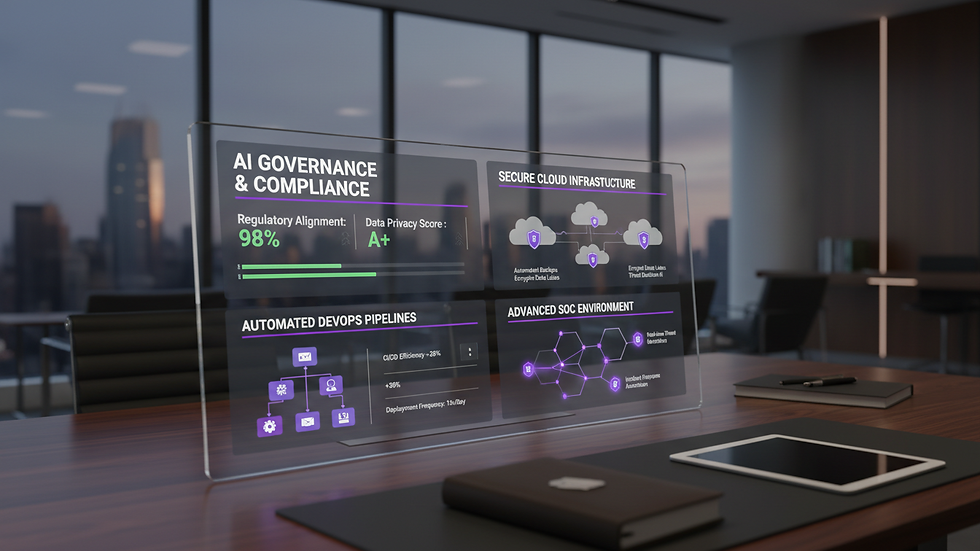
Secure DevOps Pipelines: Integrate security checks and compliance validations into CI/CD workflows for AI models.
By embedding zero-trust principles, enterprises can reduce the attack surface and ensure that AI governance controls are not bypassed. This approach also supports compliance with stringent regulatory requirements by providing detailed access logs and audit trails.
Practical Implementation Steps
Deploy identity federation and multi-factor authentication (MFA) for all AI platform users.
Use network segmentation tools to create isolated environments for AI development and production.
Automate encryption key management aligned with compliance mandates.
Integrate security scanning tools into AI model build and deployment pipelines.
Leveraging Automation and Measurable Outcomes in AI Governance
Automation is critical to scaling AI governance across complex enterprise environments. Manual governance processes are error-prone and cannot keep pace with rapid AI model iterations. Automation enables:
Policy Enforcement at Scale: Automatically apply governance policies across multiple AI projects and teams.
Real-Time Compliance Monitoring: Detect and alert on compliance deviations instantly.
Audit-Ready Reporting: Generate comprehensive reports for regulators and internal stakeholders without manual effort.
Operational Efficiency: Free up security and compliance teams to focus on strategic risk management.
Measurable outcomes are essential to demonstrate the effectiveness of AI governance initiatives. Key performance indicators (KPIs) might include:
Percentage of AI models passing bias and fairness tests.
Time to detect and remediate governance violations.
Number of automated compliance checks executed per deployment.
Reduction in security incidents related to AI systems.
Integrating AI Governance with Cloud Transformation and Network Modernization
AI governance solutions must align with broader enterprise technology strategies such as cloud transformation and network modernization. Cloud platforms offer scalability and flexibility but introduce new governance challenges:
Multi-Cloud Complexity: Managing AI governance across diverse cloud environments requires unified policy frameworks.
Hybrid Architectures: Ensuring consistent governance between on-premises and cloud AI workloads.
Network Security: Modernizing networks with software-defined perimeter (SDP) and secure access service edge (SASE) architectures to support AI governance.
Enterprises should adopt a holistic approach that integrates AI governance with cloud security and network modernization efforts. This includes leveraging cloud-native security services, automating governance workflows, and adopting zero-trust network models.
Recommendations for Seamless Integration
Use cloud-native AI governance tools that support multi-cloud environments.
Implement centralized policy management platforms for consistent enforcement.
Modernize network infrastructure to support secure, low-latency AI data flows.
Collaborate closely between AI teams, cloud architects, and security operations.
Partnering with Experts for Effective AI Governance Compliance
Given the complexity and evolving nature of AI governance, many enterprises benefit from engaging specialized consulting services. These experts bring deep engineering knowledge, regulatory insight, and practical experience in deploying AI governance solutions that balance risk and agility.
For organisations seeking to enhance their AI governance posture, leveraging online ai governance consulting can provide:
Tailored governance frameworks aligned with industry regulations.
Integration strategies for zero-trust security and cloud modernization.
Automation roadmaps for scalable compliance.
Continuous advisory support to adapt to emerging risks and standards.
By partnering with trusted advisors, enterprises can accelerate their AI governance maturity, reduce compliance risks, and unlock the full potential of AI-driven innovation.
Ensuring compliance with AI governance solutions is a strategic imperative for technology leaders managing complex, regulated environments. By focusing on engineering depth, zero-trust security, automation, and measurable outcomes, organisations can build resilient AI systems that drive business value while maintaining robust control. The path to effective AI governance is continuous and requires a proactive, integrated approach aligned with broader cloud and security initiatives.


Comments